
Uncategorized
EUDR Compliance for Vietnamese Coffee Exporters: What European Buyers Now Require

Sep
EUDR coffee compliance is now a condition of doing business with European buyers, not a future concern. The European Union consumes almost a quarter of the world’s coffee. That makes it the largest single coffee market globally. Starting December 30, 2026, a new EU regulation will decide which coffee shipments can enter the market. As a result, Vietnamese exporters need to prepare well before that date, not after.
Quick answer: The EU Deforestation Regulation (EUDR) sets three conditions for coffee sold in the EU: it must come from land that has stayed deforestation-free since December 31, 2020, follow all local production laws, and carry a Due Diligence Statement with plot-level farm geolocation. Large and medium operators must comply by December 30, 2026. Micro and small enterprises follow by June 30, 2027.
What Is the EUDR?
The EU Deforestation Regulation (Regulation (EU) 2023/1115) entered into force in mid-2023. It covers seven commodities linked to global deforestation: cattle, cocoa, coffee, palm oil, rubber, soy, and wood. Coffee falls fully within its scope, including green, roasted, and decaffeinated coffee under HS heading 0901. For full regulation details, check the European Commission’s deforestation page.
What Are the Three EUDR Requirements for Coffee?
Coffee entering the EU market must meet three conditions:
- Deforestation-free, the land must show no deforestation or degradation after December 31, 2020
- Legally produced, the coffee must comply with all relevant laws in the country of production
- Documented, a Due Diligence Statement (DDS), filed in the EU’s information system with plot-level geolocation data for every farm in the supply chain; the rule allows no sampling
EUDR Coffee Compliance Timeline: When Does It Take Effect?
The EUDR’s timeline has shifted more than once since 2023. As a result, exporters should confirm current dates rather than relying on older references:
- December 30, 2026: large and medium operators and traders
- June 30, 2027: micro and small enterprises
In May 2026, the European Commission published a simplification package that cut projected annual compliance costs by roughly 75% versus the original rules, while keeping the core deforestation-free and traceability requirements in place. Changes included a lighter DDS process for small primary operators, recognition of existing certification schemes as supporting evidence, and an upgraded IT filing system.
Who Is Responsible for Filing the Due Diligence Statement?
Under EUDR, the operator, generally the first company placing the coffee on the EU market, is legally responsible for filing the DDS. In most import chains, that’s the EU-based importer or roaster, not the exporting company in Vietnam. That does not remove the burden from exporters. Importers cannot file a credible DDS without accurate, farm-level data from their suppliers, so EU buyers are already asking exporters and cooperatives for:
- GPS coordinates or plot boundaries for every farm in the supply chain
- Evidence that land was not deforested after December 31, 2020
- Documentation of legal land use and production compliance in Vietnam
What Should Vietnamese Coffee Exporters Do to Prepare?
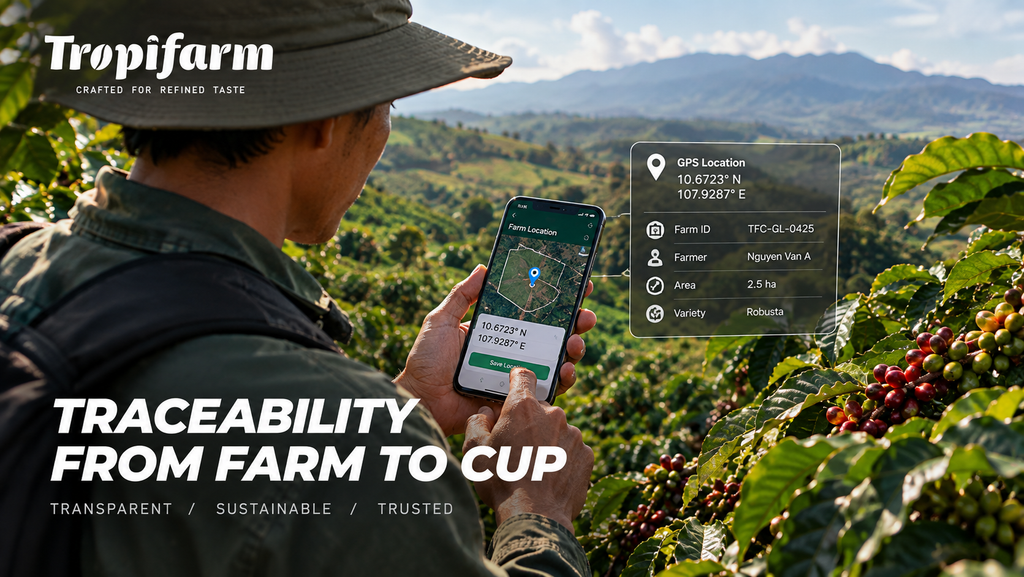
Vietnam is the world’s second-largest coffee producer, built on millions of smallholder plots, exactly the kind of fragmented supply chain that makes EUDR documentation harder to assemble quickly. Practical priorities for exporters:
- Map the supply base down to individual farm or plot level, not just district or cooperative level
- Digitize origin records so geolocation and harvest data can be shared quickly with buyers
- Review current certifications (Rainforest Alliance, UTZ, and similar schemes), several of which are being aligned with EUDR as supporting due diligence evidence
- Communicate early with EU buyers about what documentation is ready now versus in progress
How Is Tropifarm Preparing for EUDR Coffee Compliance?
Tropifarm sources coffee from mapped growing regions in Gia Lai’s Central Highlands and is building out farm-level origin documentation to support buyers navigating EUDR and similar traceability requirements. This connects directly to our existing sourcing practices see Sustainable Coffee Sourcing & Traceability in Vietnam. For companies planning to enter the EU market including through a European subsidiary or distributor relationship EUDR readiness is worth addressing before the first shipment is negotiated, since buyers increasingly use traceability readiness as a first-round supplier filter. Export documentation such as Phytosanitary and Fumigation Certificates, covered in our Vietnam Roasted Coffee Beans Wholesale & OEM guide, sits alongside EUDR’s Due Diligence Statement as part of a complete shipment file.
Tropifarm – Vietnam Coffee Exporter
Hotline: +84 989 879 867
Email: Kim@winwincorpjsc.com
Website: vietnamtropifarm.com
Frequently Asked Questions (FAQ)
A: December 30, 2026 for large and medium operators, and June 30, 2027 for micro and small enterprises.
A: Both. EUDR covers coffee under HS heading 0901, including green, roasted, and decaffeinated coffee.
A: The operator placing the coffee on the EU market usually the EU-based importer or roaster files the DDS, but they depend on farm-level geolocation data supplied by the exporter.
A: Yes, several certification schemes are being aligned with EUDR and can support due diligence evidence, though they do not replace the DDS filing itself.
A: Yes. Tropifarm is building farm-level origin documentation for its Gia Lai supply base to support buyers preparing for EUDR.


Pingback: Robusta for Espresso: Vietnam Fine Robusta from Gia Lai